My PhD in Depth
AI is increasingly deployed in high-stakes domains, yet it continues to raise significant ethical and societal concerns. While many organizations have defined ethical principles to ensure the trustworthiness of AI systems, these principles often remain difficult to operationalize and may even conflict when assessed independently. In parallel, regulatory frameworks such as the GDPR highlight the right to explanation as central to building trust in AI, emphasizing the importance of transparency in decision-making. Building on this insight, my PhD investigates transparency not merely as a means to explain individual AI decisions, but as a principled tool for auditing AI systems as a whole. In particular, my research addresses the following questions.
What type of transparency enables meaningful auditing of AI systems?
Transparency in AI typically refers to the explanations used to account for model outputs, which can be characterized by their scope (local vs. global) and their level of rigor (non-formal vs. formal). In this work, we focus on formal explanations, instantiated through abductive and contrastive reasoning. In particular, formal abductive explanations, which answer why a decision was made by identifying its justifying conditions, are well suited for diagnostic analysis and therefore form the core explanatory mechanism of our auditing frameworks. This choice is inspired by influential works in explainable AI and reasoning [Ref1, Ref2].
How can this transparency assess proxy discrimination and unfairness?
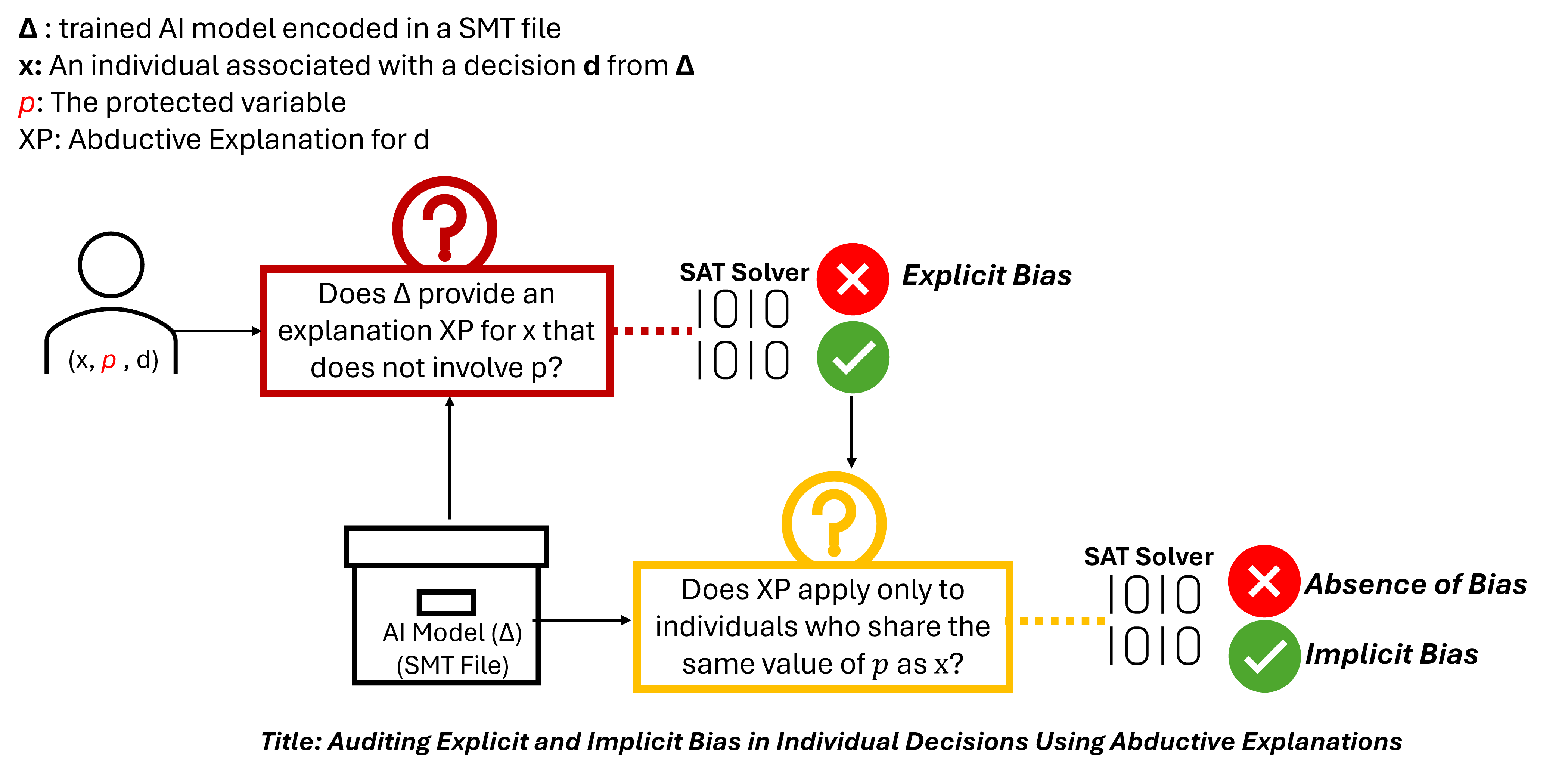 When discussing unfairness and proxy discrimination (Implicit Bias), the focus is on how certain protected features influence a model’s decisions. Using abductive explanations, we define proxy discrimination as the model’s ability to provide explanations that apply only to individuals within the same subgroup, that is, individuals sharing the same value of a protected attribute. For unfairness, we introduce the concept of aptitude, derived from abductive explanations, which is a property independent of subgroup membership. Fairness is ensured when all individuals satisfying the same aptitude receive the same model outcome. [Accepted at Australasian Joint Conference in Artificial Intelligence 2025].
[Article].
When discussing unfairness and proxy discrimination (Implicit Bias), the focus is on how certain protected features influence a model’s decisions. Using abductive explanations, we define proxy discrimination as the model’s ability to provide explanations that apply only to individuals within the same subgroup, that is, individuals sharing the same value of a protected attribute. For unfairness, we introduce the concept of aptitude, derived from abductive explanations, which is a property independent of subgroup membership. Fairness is ensured when all individuals satisfying the same aptitude receive the same model outcome. [Accepted at Australasian Joint Conference in Artificial Intelligence 2025].
[Article].
How can this transparency assess privacy leakage?
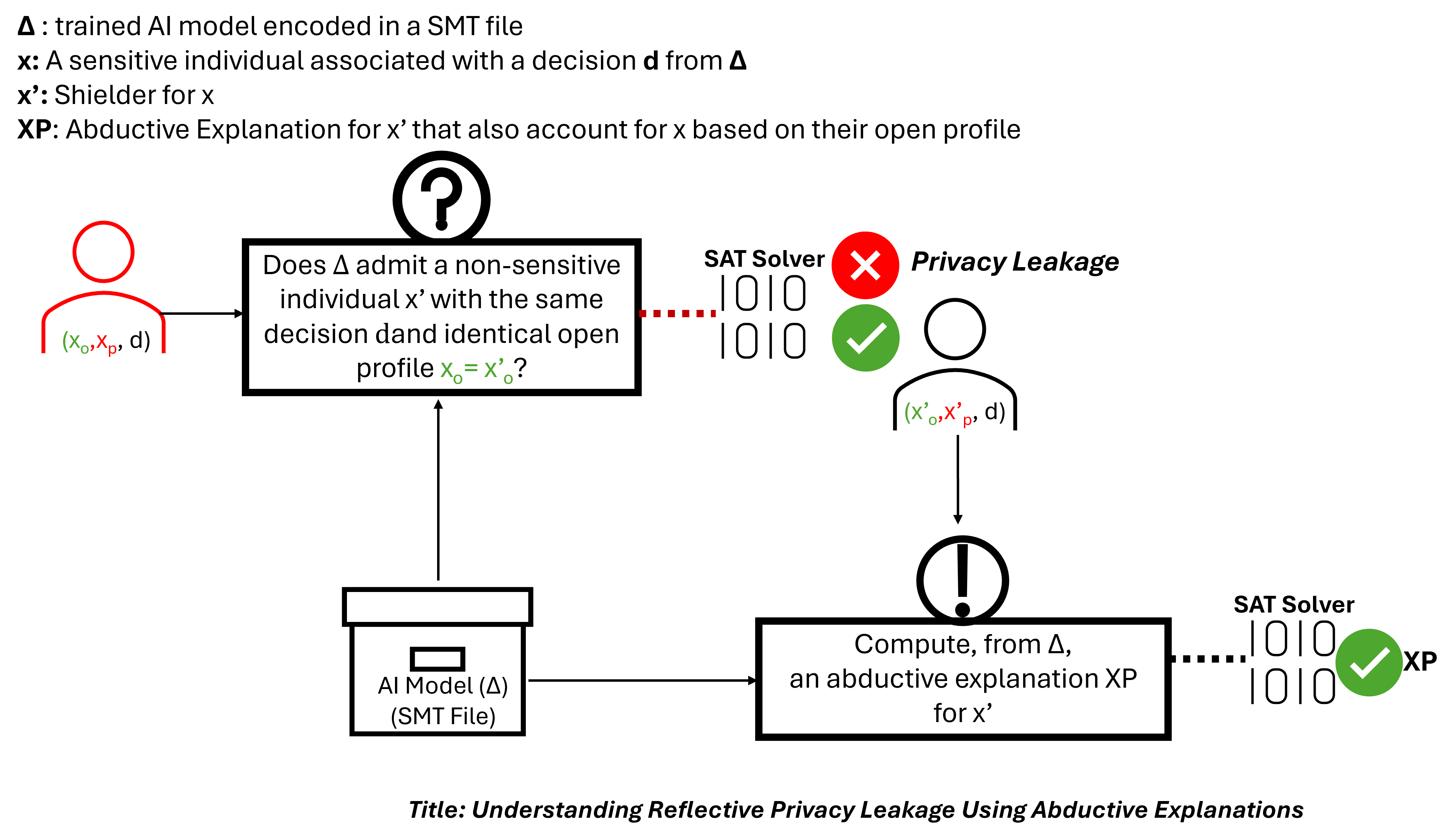 We study reflective privacy leakage, which occurs when an AI model’s outputs reveal sensitive information about individuals. Our approach distinguishes between open and private variables, partitioning each individual’s features into an open profile, which is publicly accessible, and a private profile, which should remain hidden. Within this framework, individuals are classified as sensitive or non-sensitive. Using abductive explanations, we define privacy preservation for a sensitive individual as the model’s ability to produce an explanation that applies to both that individual and at least one non-sensitive individual based solely on their shared open profile. When such an explanation exists, the model is said to guarantee a shielder, and assessing privacy leakage amounts to verifying whether every sensitive individual admits one. [Accepted at Post-AI Formal Methods at AAAI-26].
[Workshop Paper]. Furthermore, we propose a repair methodology that enforces this property, guaranteeing that every sensitive individual admits a shielder [submitted under review]
We study reflective privacy leakage, which occurs when an AI model’s outputs reveal sensitive information about individuals. Our approach distinguishes between open and private variables, partitioning each individual’s features into an open profile, which is publicly accessible, and a private profile, which should remain hidden. Within this framework, individuals are classified as sensitive or non-sensitive. Using abductive explanations, we define privacy preservation for a sensitive individual as the model’s ability to produce an explanation that applies to both that individual and at least one non-sensitive individual based solely on their shared open profile. When such an explanation exists, the model is said to guarantee a shielder, and assessing privacy leakage amounts to verifying whether every sensitive individual admits one. [Accepted at Post-AI Formal Methods at AAAI-26].
[Workshop Paper]. Furthermore, we propose a repair methodology that enforces this property, guaranteeing that every sensitive individual admits a shielder [submitted under review]
How can this transparency improve healthcare decision-making and clinician–AI alignment?
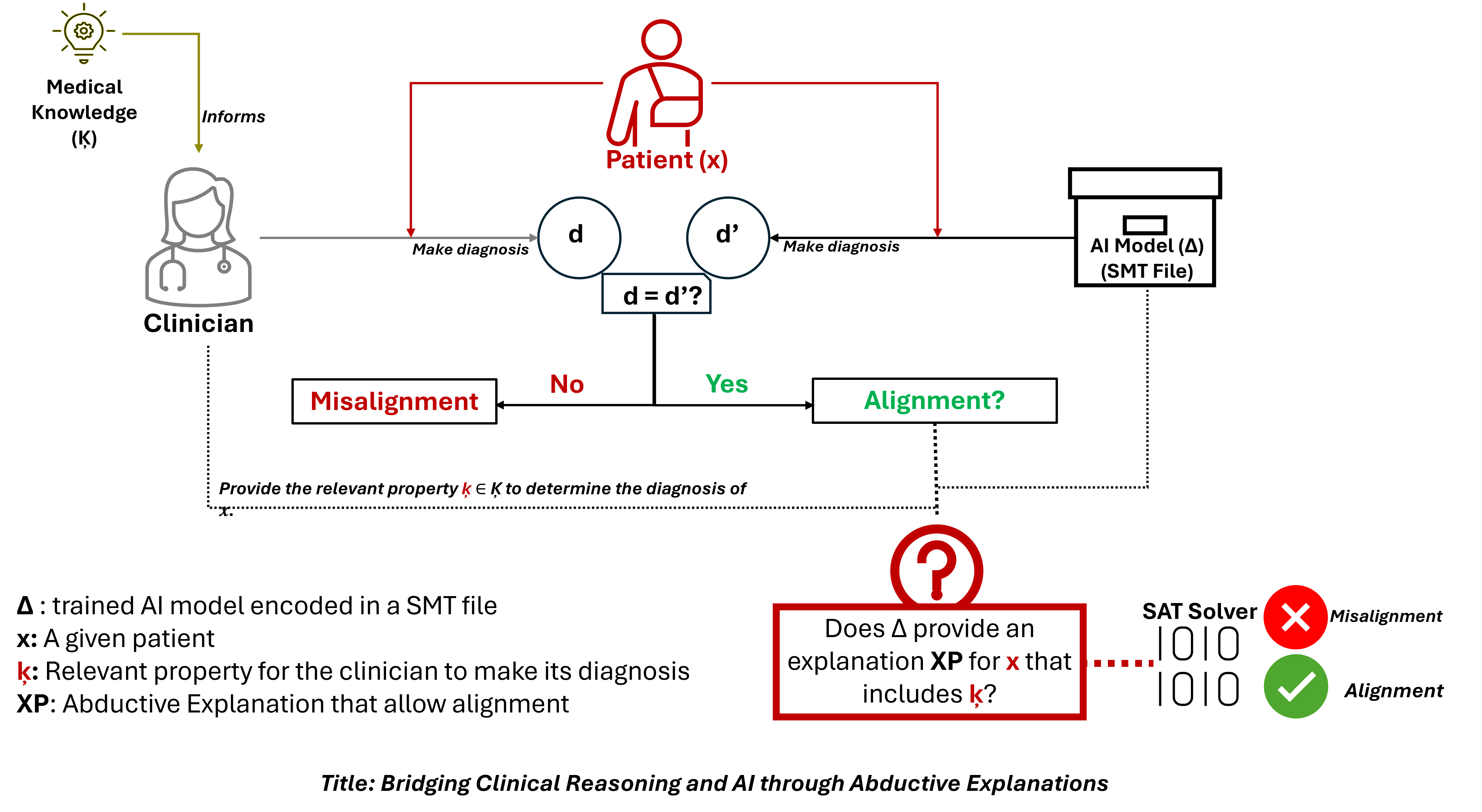 Although AI has demonstrated strong potential in healthcare decision-making, sometimes surpassing clinicians in diagnosis, its integration into clinical practice remains limited. A key challenge is the lack of trust in AI reasoning, as clinicians are often uncertain whether model decisions rely on clinically meaningful facts. While clinicians typically base diagnoses on specific clinical evidence, AI systems may justify the same diagnosis using alternative patterns learned from data. Since abductive explanations reveal model reasoning by identifying all formal hypotheses supporting a decision, we investigate how they can be used to bridge clinical reasoning and AI reasoning. We show that an AI model’s diagnosis is aligned with clinical reasoning if it provides at least one explanation that includes a clinically relevant fact [Accepted at Adaptive Learning & Intelligent Systems 2026].